
SAS Astronomy Picture of the Month [March, 2026]
Leo Triplet, Interacting Galaxies and Jupiter!
M96 in Leo is part of a triad consisting of M95, M96 and M105. The latter is also part of a close triad, but I can’t find information on the others of that triple. M94, at a distance of about 41 Mly is only 1/3 the distance of the pair below. But on its outer edge is a background edge-on spiral (2MFGC 8391) sitting at a distance of about 700 million light years. To its upper right are to other distant galaxies. M96 has a visual magnitude of about 9.2 and an angular size of 6’ x 4’. Its brilliant core has a non-stellar nucleus. It is a double barred intermediate spiral Type SAB(rs)ab with an off-center core. The dust lanes are unsymmetrical and arms are poorly defined.
This object was a real challenge because the first two nights of imaging were plagued by intermittent thin clouds resulting in about 70% rejection of my subs. Finally I had a third night that was clear most of the time, but as with the previous 2 attempts, the seeing was only marginal. I also had to redo my flats. So ultimately I ended up with 63 acceptable 3 min. subs, all from the last night, for the image below. Total integration time: 3 hr. 9 min.
References: SkySafari Pro, Wikipedia, and Astrodrudis (https://astrodrudis.com/messier-96-ngc-3368/) Compare to Astrodrudis image taken with a 24” f/6.5 reflector with a total exposure of 18.5 hr.
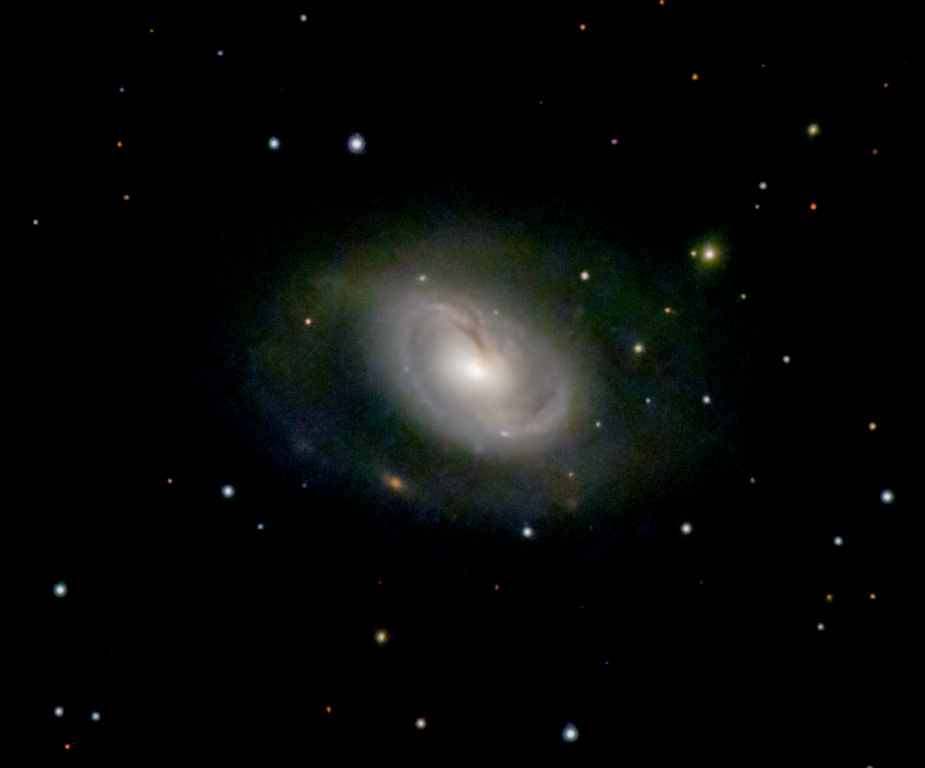
M96 – Member galaxy of the Leo Triplet by David Murray
IC 2163 & NGC 2207 Interacting galaxies in Canis Major
IC 2163 is a 11th magnitude Spiral Galaxy appearing in the constellation Canis Major. It is 121 million light years from our solar system. It appears roughly 3.4 x 0.9 arcminutes in size, corresponding to a physical diameter of 118073 light years. It is a spiral galaxy of morphological type Sc, and is receding at 2788 kilometers per second – about 0.9% of light speed. It is the smaller of the two galaxies and passed behind NGC2207 in the distant past, initiating star formation in both galaxies.
Unfortunately it only rises 26° above the southern horizon. Right now the pair transits just before 8 PM and sets at about 12:30 AM, so there is not much time to catch it at a decent altitude
NGC 2207 is the brighter? and larger of two interacting galaxies with a 1.5′ x 1′ halo elongated ENE-WSW and containing a bright core. It has a magnitude of 11.47. I can’t find a consensus on the visual magnitude of this galaxy with values ranging from 10.21 to 12.3.
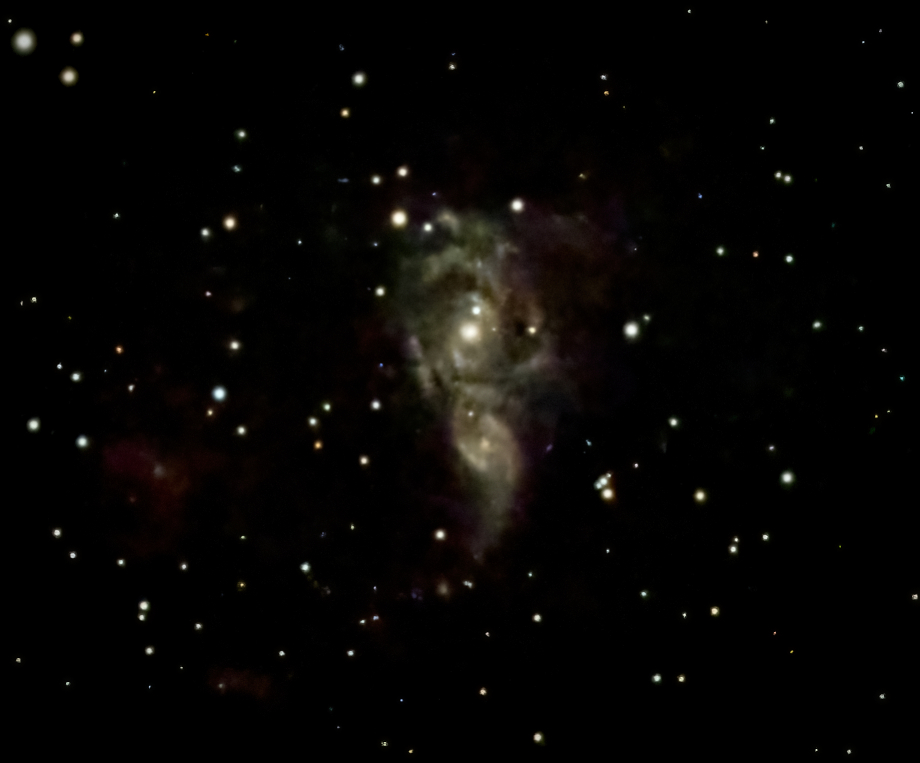
IC 2163 & NGC 2207 Interacting galaxies in Canis Major by David Murray
I finally had some non-horrible seeing for a change. I took this just last night during my usual 2 hour window opportunity between trees. I posted an excerpt from the corresponding video just to show the kind of image you typically get through a video camera. It’s hard to believe you can extract the enhanced image (left) from the noisy image you see in this gif, but programs like AutoStakkert or Registax (freeware) do an outstanding job. I stacked about 25% of the best frames out of a 90sec movie clip (consisting of about 11,000 frames) For anyone just starting in planetary imaging, this image probably looks pretty good, but only at this scale. Magnify it and it looks quite unimpressive. It’s a very far cry from what is possible in better seeing conditions.
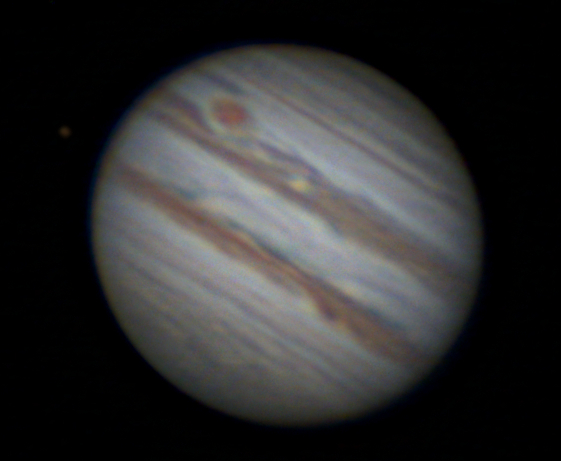
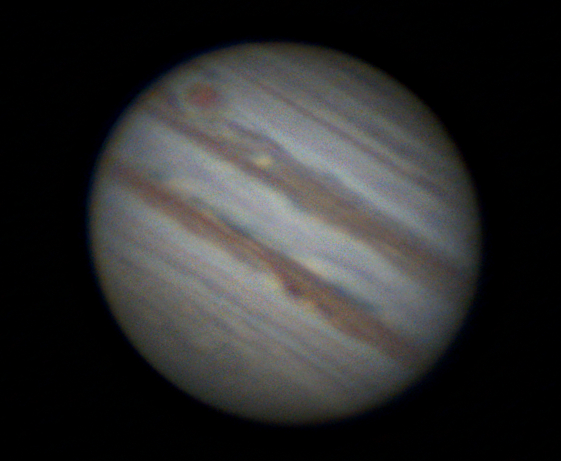
Jupiter and Io near opposition – by Terry Riopka