
SAS Astronomy Pictures of the Month [January, 2026]
Hubble's Ghost and Andromeda's Parachute
NGC 2261 is a variable reflection nebula located in the constellation Monoceros, about 2.500 light-years away. Although first recorded by William Herschel in 1783, it is popularly called Hubble’s Variable Nebula since Edwin Hubble was the first one to notice the brightness changes over more than 25 years.
The nebula is illuminated by the star R Monocerotis and it manifests changes in the overall brightness over short periods of time. R Monocerotis is a young stellar object, a pre-main sequence star that has not yet started to fuse hydrogen in its core. It is still accreting material from its birth cloud. This is a massive Herbig Ae/Be star with up to 10 times the Sun’s mass and an age of just 100.000 years. The disk around the star has a mass of 0,007 solar masses and it extends to 150 AU from the star. There is also a T-Tauri companion in the vicinity.
One explanation proposed for the variability is that dense clouds of dust near R Monocerotis periodically block the illumination from the star. This casts a temporary shadow on the nearby clouds. Another reason might be that R Monocerotis is a variable star, with ranges up to 4 magnitudes.
This was a 60 min exposure taken using a C6 f/10 with an ASI533 camera and an Optolong L-Pro filter – processed in PixInsight and Photoshop.
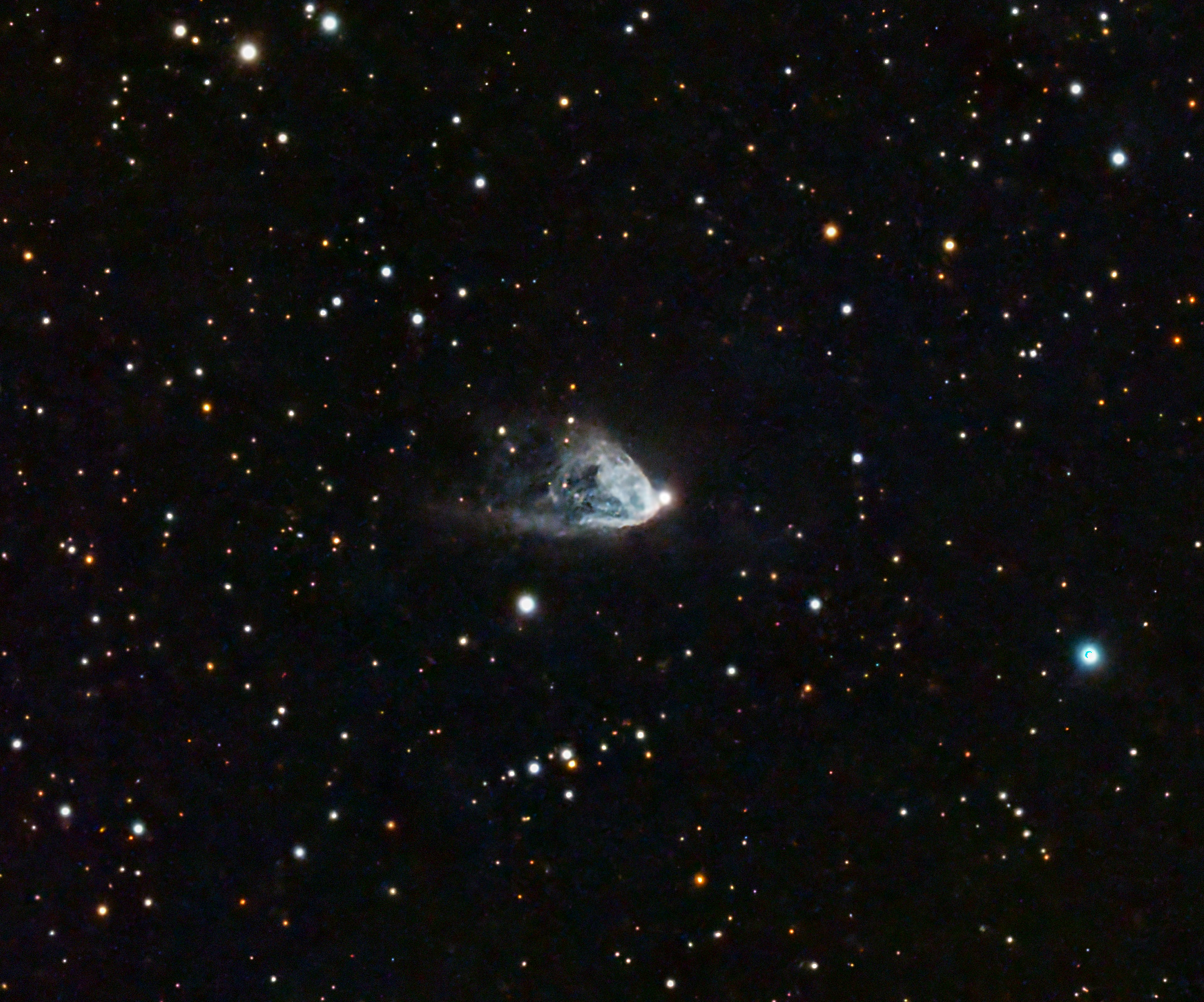
Hubble’s Ghost Nebula in Monoceros – by David Murray
Andromeda’s Parachute is a quadruple gravitationally lensed quasar, designated as PS J0147+4630 and located in Andromeda. It was discovered in 2017 by the Panoramic Survey Telescope and Rapid Response System (Pan-STARRS1). The Pan-STARRS1 image is shown at the bottom as a reference. The four star-like images comprising the “parachute” are of a quasar whose light left it about 11 billion light years ago, gravitationally magnified and split into 4 by a foreground galaxy (G not visible but located just above image D). We’re seeing the light of an object that came into existence only about 2.5 billion years after the big bang!
Interestingly, quadruple lensed quasars are valuable objects for study. Because the quasar is not exactly on the opposite side of the lensing galaxy, the different images take different amounts of time to get to us. And because the quasar varies in brightness, time delays of the various images of the quasar can be accurately measured. These timings help astrophysicists to estimate the rate of expansion of the Universe (the Hubble constant) and map its space-time geometrical structure!
I acquired this over several nights in the November 2025 with my 12″ Classic Meade and focal reducer on a Paramount MyT, using a cooled ASI2600mc camera. Out of three nights and about 7 hours of imaging, only 68 30sec frames were selected for the full Andromeda’s Parachute view, but only 9 frames made it into the final image partially resolving the lensed quasar images!
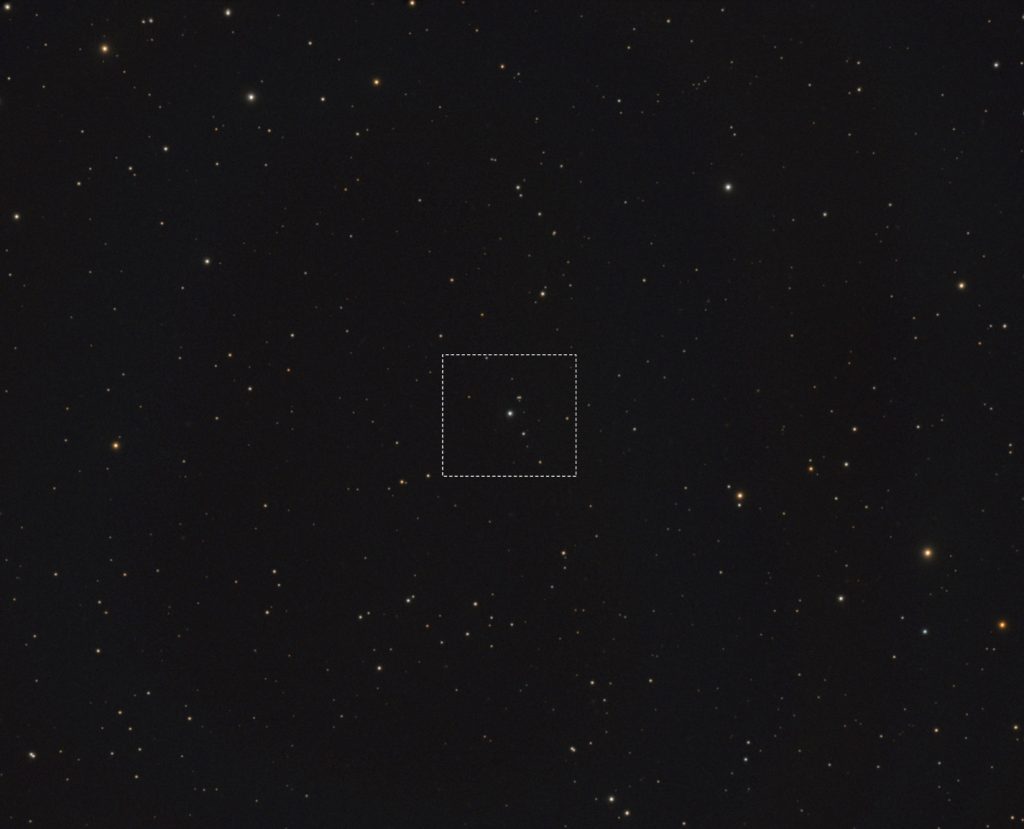
Quadruple Gravitationally Lensed Quasar (annotated FOV) by Terry Riopka
This is not an easy object to image. The three images in the arc are each separated by about 1″, requiring lucky imaging to resolve them. The brightened version below was obtained from stacking 68 of the sharpest images. It clearly shows the entire “parachute” but point sources B and C melt into each other. Point source D is about 3″ from the arc, and easily resolved.
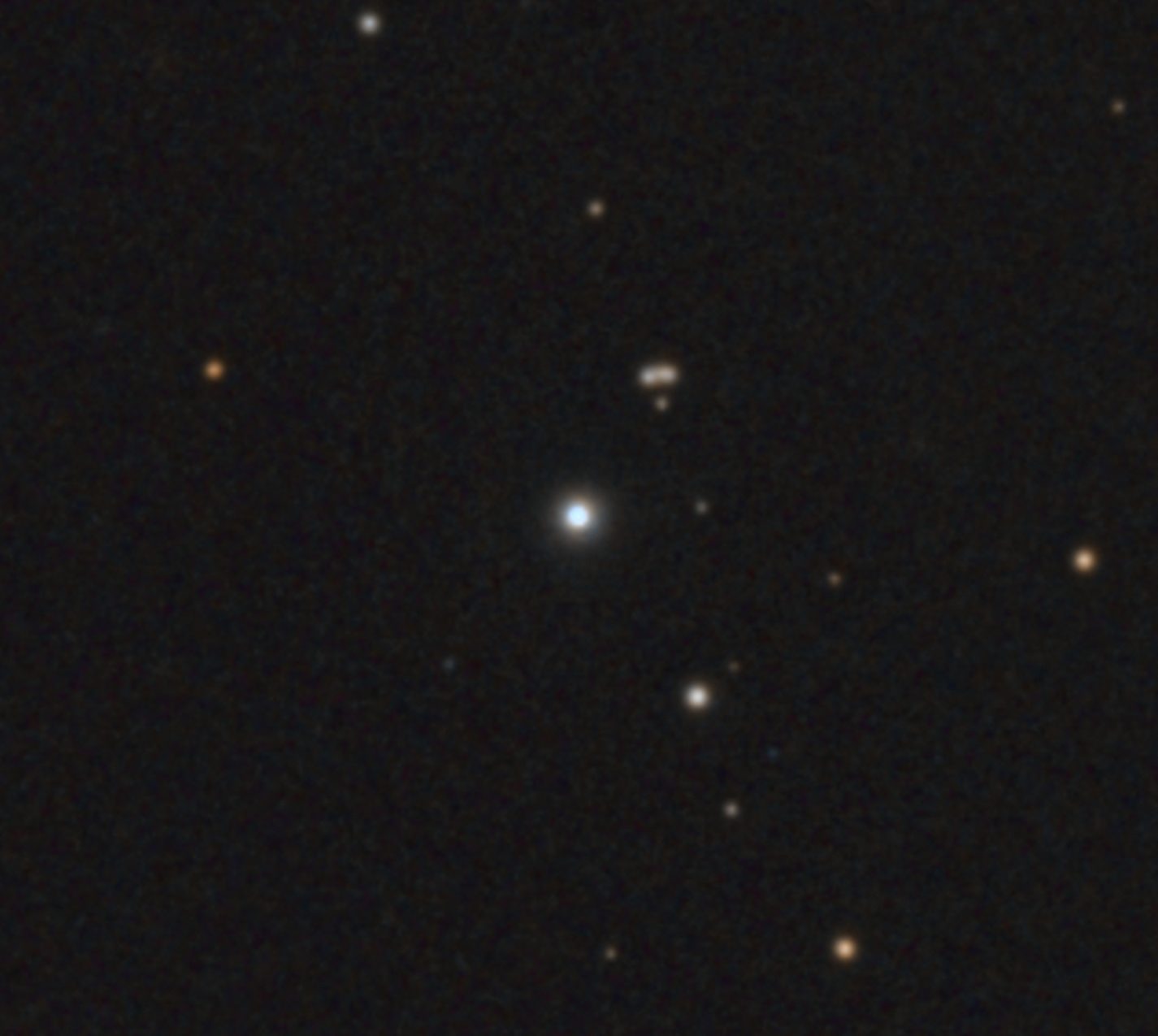
Quadruple Gravitationally Lensed Quasar (34 min exposure close up), by Terry Riopka
Out of about 860 30sec exposure images, only 9 were focused enough to warrant stacking to obtain the final image below. Even then, though A and B are clearly resolved, point source C, which is about a magnitude fainter than the other two, barely shows up in the image.
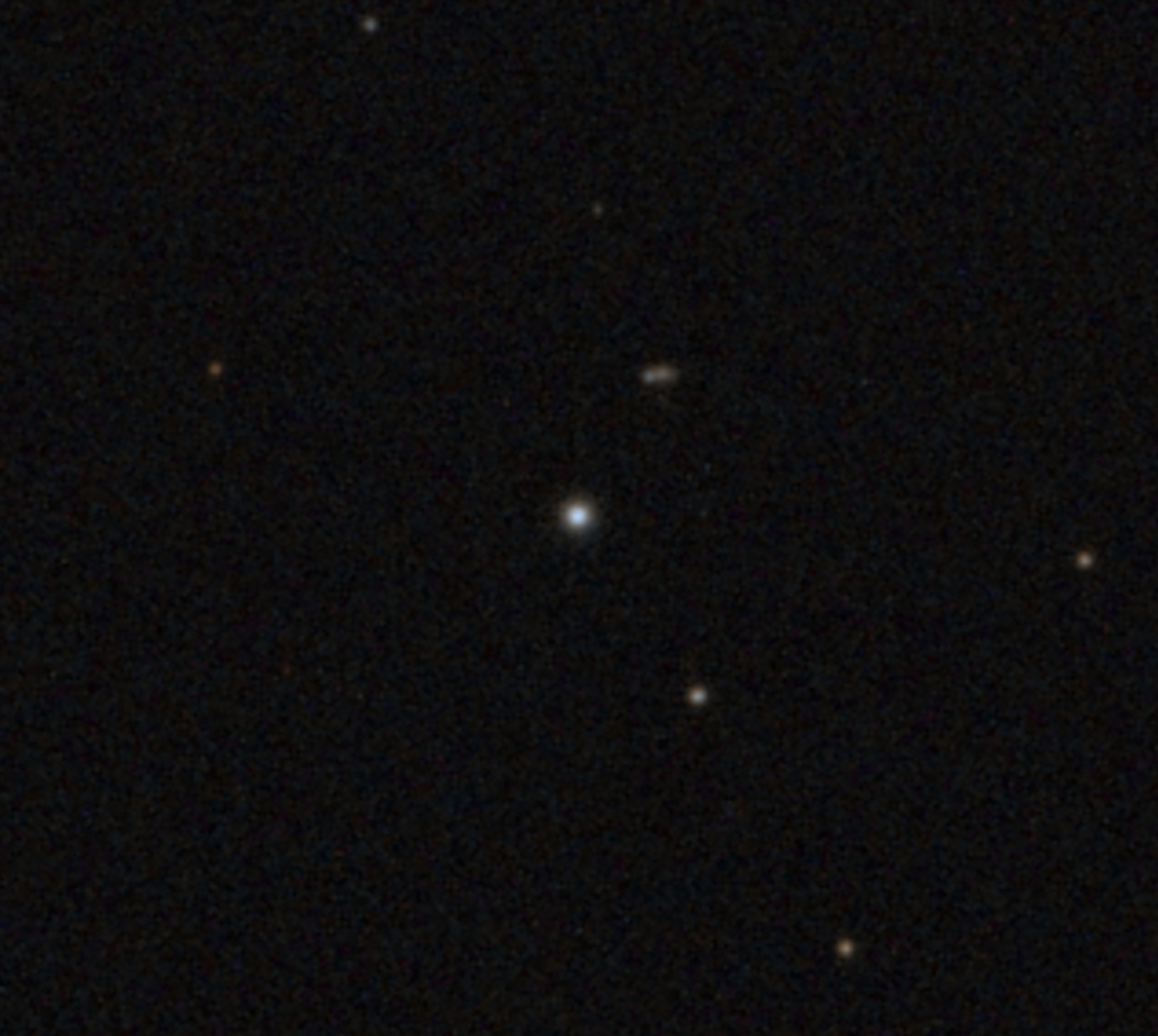
Quadruple Gravitationally Lensed Quasar (4.5min exposure close up), by Terry Riopka
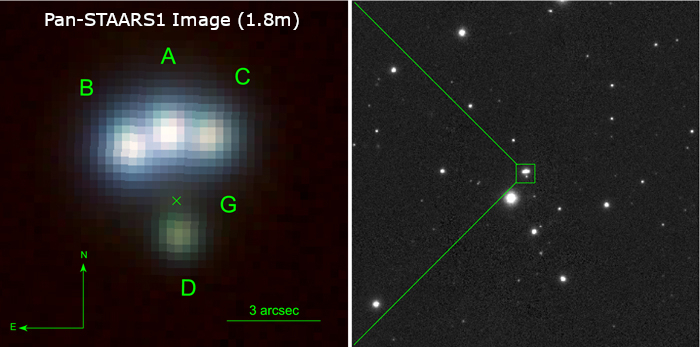
Quadruple Gravitationally Lensed Quasar, by Pan-STAARS1