
SAS Astro-Challenges of the Month [June, 2026]
Challenges in Hercules and Ursa Major!
This month's prize: Starfinder: The Complete Beginner's Guide to Exploring the Night Sky by Stott and Sparrow
Astro-Challenge General Instructions: To win the prize: • 1. Read, understand and follow each of the instructions. This the most important one. Failure to follow the full instructions will automatically disqualify your entry. • 2. Participation is open to any person living within 100 miles of the Skylight Observatory. Executive SAS members are not eligible. • 3. Choose one challenge below, either visual, binocular, or telescope. • 4. Go out one clear night (or more depending on the challenge) and follow the challenge instructions. • 5. Answer the associated questions for that challenge. • 6. Email proof of your accomplishment to sas_astro_challenge@kantbelievemyeyes.com. Generally, the easiest proof is to take a picture with your cell phone of whatever is asked of you and email that. • 7. With your email, provide the name you prefer to use, and your approximate age (pre-teen, teen, young adult, older adult) • 8. All entries must be received before midnight on the night just before the meeting for the month of the challenge. • 9. Some number (1 or more) will be selected randomly from all the valid entries. • 10. Winners will be notified by email the day after the meeting, at which point arrangements will be made to enable them to obtain their prize. See telescope bonus below. That's it! Good luck
This month’s observer’s tip; Using imaginary lines or curves drawn from stars and constellations you know can help you find stars and constellations you are less familiar with.
The theme of this month’s challenge is pairs, double stars, a pair of globulars, and a pair of galaxies.
In mid-June, M81/M82 transit at about 17:00 (5 p.m.) and are at an altitude of 41° in the NW at about 10:30 p.m. Next to transit is Mizar at 20:30 and is at an altitude of 66° in the NW at 10:30 p.m. Finally, M13 and M92 transit at about midnight in mid-June and are about 70° above the eastern horizon at 10:30 p.m. Note, in mid-June it is not astronomically dark at our latitude and longitude until about 10:30 p.m.
For the Visual challenge, the pair is Mizar and Alcor, located at the bend in the handle of the Big Dipper in Ursa Major. The pair is spectacular in binoculars.
Sharp eyes and a fairly dark sky are necessary to spot Alcor.
- Describe their relative brightness.
- Make a drawing of the stars in the Big Dipper showing the position of Alcor with respect to Mizar. Do they appear to have any color?
- Compare their apparent relative brightness.
- If you really can’t spot Alcor with your own eyes, use binoculars to help you
- To submit your entry, take a picture of your drawing with a cell phone, and email it to sas_astro_challenge@kantbelievemyeyes.co
For the Binocular challenge, you must find the globular clusters M13 and M92.
Both clusters are located in the constellation Hercules. M13 is relatively easy to find in the keystone (or chest) of Hercules. Hint: search from star to star around the keystone, and you should eventually run into it. M92 is more challenging, forming a triangle with Pi and Eta Herculis in the northern side of the keystone. Refer to the star chart linked below for help finding Hercules and the two clusters.
Compare the two with respect to size and brightness. For your entry, make a rough drawing of at least the keystone (and more stars if you can) and indicate in the drawing where M13 and M92 are located. Take a picture of your drawing and email it along with your answer about size and brightness to: sas_astro_challenge@kantbelievemyeyes.com.
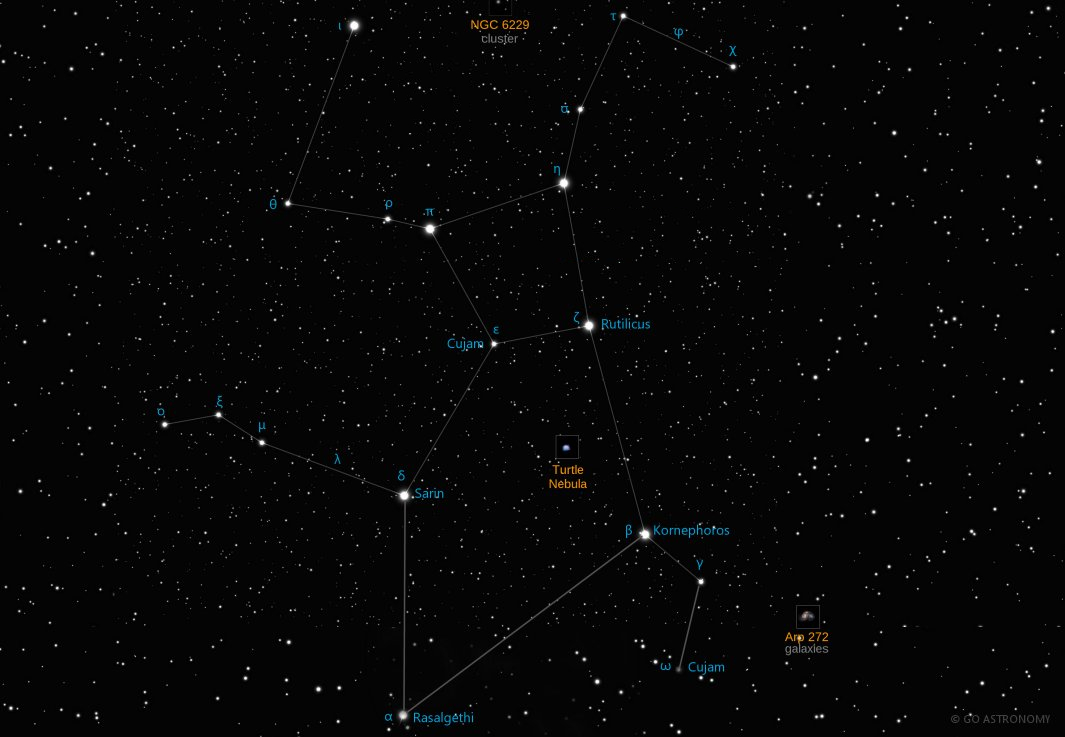
Astro-challenges of the month – Hercules
For the Telescope challenge: observe/draw or observe/photograph the pair of galaxies, M81 & M82: M81 is often designated Bode’s Galaxy and M82, the Cigar Galaxy, names which should give you a hint as to how to distinguish the two. If you do not have GOTO capability, here are instructions to find them manually. The galaxy pair lies on the west side of constellation Ursa Major (i.e. to the right of the bowl when you look up). Dubhe is the top right star of the bowl. Phecda is a star diagonally across it on the bowl. Extend a diagonal line from Phecda to Dubhe in the bowl of the Big Dipper (Ursa Major) and continue about the same distance from Dubhe to where the galaxies should be located.
Compare and contrast these two galaxies, shape, brightness, and separation. Make a drawing OR acquire a digital image if you have the capability. For your entry:
- For a drawing entry: draw a circle around your galaxies to show your field of view. Take a picture of your drawing and email it along with a mention of the telescope and eyepiece magnification used. Also, mention or indicate in the drawing which galaxy is M81 and which is M82 (using the hints above).
- For a digital image entry: Email your image along with a mention of the telescope, camera and exposure used, and describe which galaxy is which.
Send your email to: sas_astro_challenge@kantbelievemyeyes.com
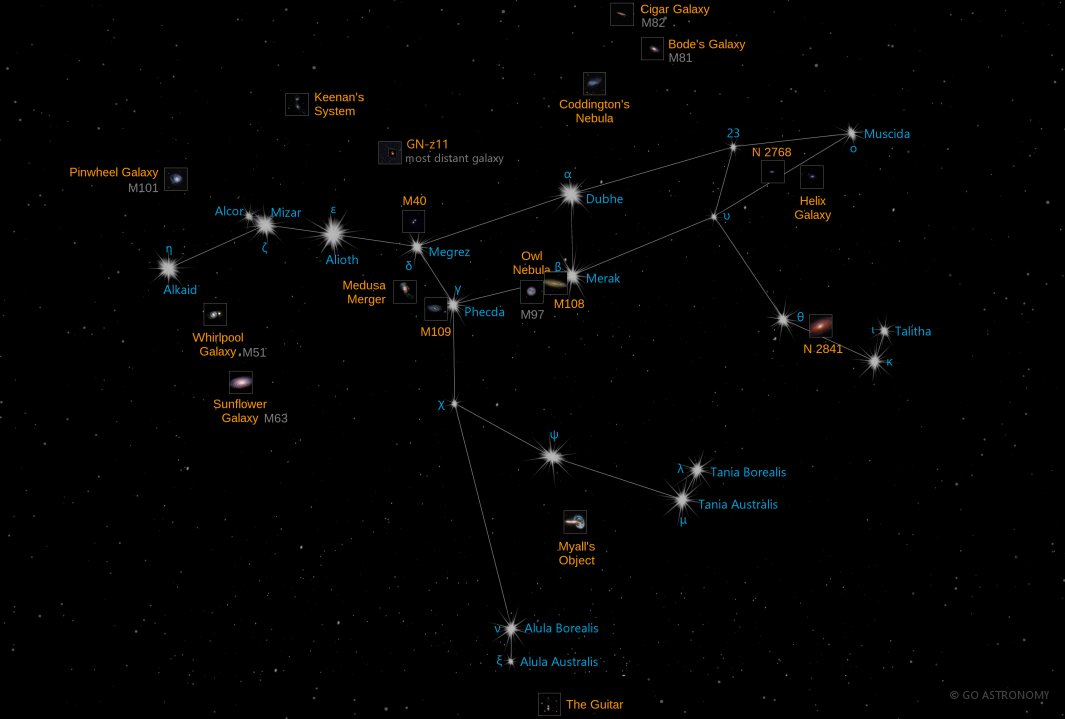
Astro-challenges of the month – Ursa Major