
SAS Astro-Challenges of the Month [February, 2026]
Orion Challenges with (ongoing) BONUS Uranus Challenge
This month’s observers tip: AVERTED VISION is the visual astronomer’s secret weapon! Your peripheral vision is more sensitive to low light. Whenever looking at faint objects, always look just off to the side instead of directly at the center of the object you want to observe. This is a highly useful technique and a vital observation skill to learn. The Orion nebula is perfectly suited for testing this skill out, whether it be using your naked eyes, binoculars OR a telescope.
!!! Stay tuned for details on our FIRST incentive program Astro-Challenge, coming up next month !!!
Visual
- Orion is one of the most conspicuous constellations in the northern sky.
Write a brief description of its location in the sky at about 7 p.m. mid-month relative to other objects in the sky that you know.
- How many stars brighter than the middle star of Orion’s belt do you count? Hint: the middle star of Orion’s belt is the brightest star in the belt at magnitude 1.7
Can you name at least two?
- What are the stars in the shoulders and feet of Orion?
Describe their color.
- The three stars in Orion’s belt are quite conspicuous.
How many stars can you count in Orion’s sword?
What are the two bright stars east of Orion?
Binoculars
- The Great Orion Nebula (M42) is arguably the brightest emission nebula in the winter sky. It appears as a faint glow around the central “star” in Orion’s sword, theta Orionis.
Describe or draw the shape of the glow as it appears from your location.
How dark is your observing site and what is its location on a light pollution map?
- Orion’s sword contains three distinct groups of “bright” stars with theta Orionis at the center.
How many stars can you distinguish in each group and how does the brightness of
the groups compare?
- The three stars in Orion’s belt are all hot blue-white stars of similar brightness.
One is a bit dimmer than the other two, can you distinguish which one?
Can you make out a seahorse shaped trail of stars snaking between Alnilam and
Mintaka (the two west-most stars) in the belt?
Telescope
- Describe and/or draw the shape of the nebulosity you observe in the Orion nebula.
Do you perceive any color in the nebulosity?
- The Trapezium was believed by the ancient Greeks to be a single star. This belief persisted until 1617 when Galileo turned his telescope toward it and resolved it into what he believed was 3 stars. We now recognize eight components and six should be visible with small telescopes. The cluster is very tight.
How many stars can you count within the Trapezium? Which star is brightest?
Make a drawing.
- Rigel is the brightest star in Orion and is also what should be an easy double for small scopes with a separation of 9.4 arc-seconds. However, the brightness of Rigel — magnitude 0 — makes resolution more challenging.
Can you distinguish the companion of Rigel?
Bonus: NGC1981 is an open cluster 1 degree north of M42 (2 moon diameters) containing
40 stars of 6th to 9th magnitude. How many of these stars can you count?
Bonus: Sigma Orionis is a 4th magnitude “star” about 0.8° southwest of Alnitak.
It is actually a multiple star system consisting of 5 components ranging in magnitude
from approximately 4th to 9th arrayed more or less in a line. Components AB are too
close (0.25″) to be resolved by small telescopes but C, D and E should easily be resolved.
Component C is the closest to AB as well as the faintest.
Please describe the equipment used for your observations and your location.
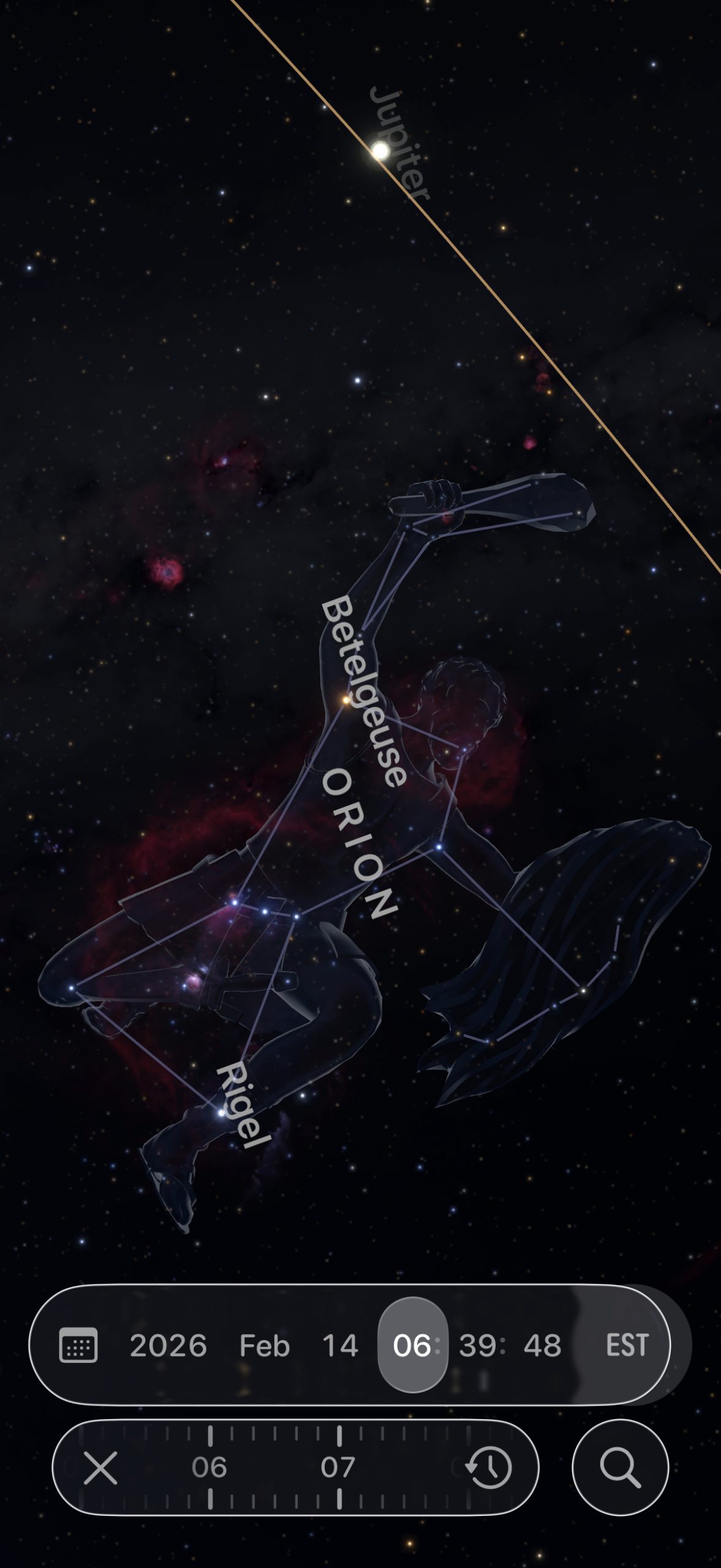
The constellation Orion and Jupiter (image obtained from “Sky Guide” version 12.0.8 for iPhone by Fifth Star Labs LLC)
ONGOING BONUS Binocular Challenge: Find Uranus using only binoculars!
Use the sky map below to locate Uranus with binoculars. Uranus lies south of the Pleiades star cluster (M45) and is easy to spot in binoculars, shining at magnitude 5.7. Look south of M45 for a pair of 6th-magnitude stars, 13 and 14 Tauri, both similar in brightness to Uranus and similarly spaced apart . Uranus is the rightmost and lowermost “star” of the three.

Challenge: Find Uranus with Binoculars! (image obtained from “Sky Guide” version 12.0.8 for iPhone by Fifth Star Labs LLC)